

Every ecommerce store wants customers who keep coming back and actually buy more. Email may seem old school next to shiny social media, but the real shock is how powerful it still is. According to Email marketing delivers an average ROI of 4200 percent for online retailers and most shoppers actually prefer special offers delivered straight to their inbox. Forget what you thought about digital newsletters being outdated. The data flips that idea on its head.
Quick Summary
| Takeaway | Explanation |
|---|---|
| Email marketing builds customer relationships | It allows personalized communication, increasing trust and engagement with customers. |
| Segmentation enhances targeting efforts | Creating detailed customer segments enables more relevant and effective email campaigns. |
| Automation improves engagement and efficiency | Triggered emails based on customer actions increase relevance and response rates. |
| Personalization leads to higher conversion rates | Tailored content makes customers feel valued, leading to increased sales and retention. |
| Data analysis drives strategic decisions | Utilizing customer data helps refine email strategies for better outcomes and ROI. |
What is Email Marketing in Ecommerce?
Email marketing in ecommerce represents a strategic digital communication approach where online retailers leverage electronic messages to connect with customers, promote products, and drive sales through targeted and personalized communication channels.
The Core Purpose of Email Marketing
At its fundamental level, email marketing serves as a direct communication method that allows ecommerce businesses to reach customers instantly and personally. Unlike broad advertising strategies, email marketing enables precise targeting, delivering specific messages to segmented customer groups based on their behaviors, preferences, and previous interactions with an online store.
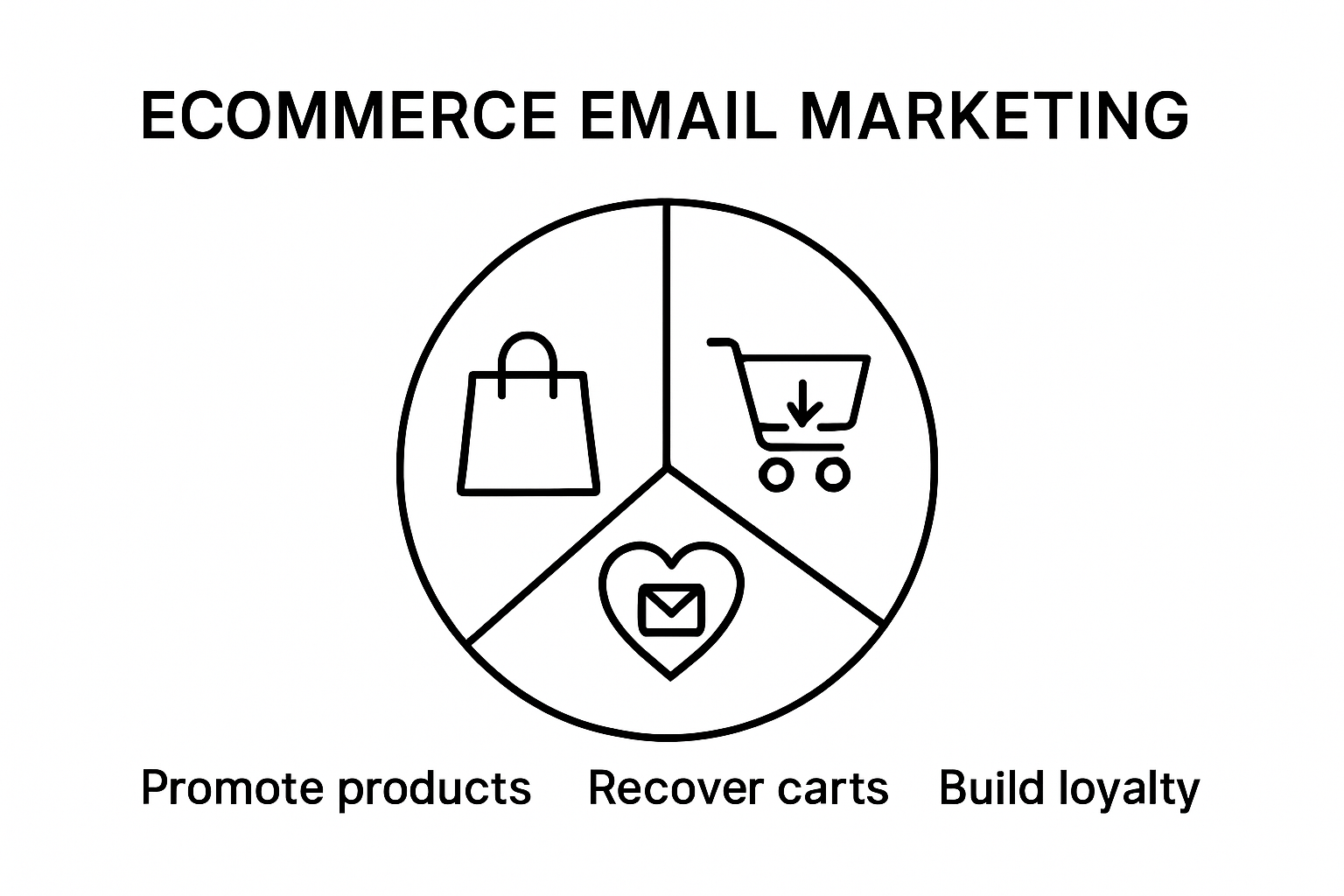
The strategic objectives of email marketing in ecommerce typically include:
- Building and maintaining customer relationships
- Promoting new products or services
- Recovering abandoned shopping cart transactions
- Encouraging repeat purchases
- Sharing personalized recommendations
How Email Marketing Functions in Digital Retail
Effective email marketing operates through sophisticated data collection and analysis mechanisms. Online retailers track customer interactions such as browsing history, past purchases, and engagement patterns to create highly personalized communication strategies. This approach transforms generic marketing messages into tailored experiences that resonate with individual consumers.
Modern email marketing platforms integrate advanced technologies that enable automatic segmentation, triggered responses, and dynamic content adaptation. These systems allow ecommerce businesses to send the right message to the right customer at precisely the right moment, significantly increasing the likelihood of conversion and customer retention.
By understanding customer preferences and utilizing intelligent targeting, email marketing becomes more than just a communication tool it becomes a powerful revenue generation strategy that connects businesses directly with their most valuable asset their customers.
The Importance of Email Communication for Online Retailers
Email communication has become a cornerstone of digital retail strategy, providing online retailers with a powerful mechanism to engage customers, drive sales, and build long-term brand relationships through direct and personalized interactions.
Driving Business Growth Through Strategic Communication
In the competitive landscape of online retail, email serves as more than just a communication tool. It represents a sophisticated channel that enables businesses to create meaningful connections with their customer base. By delivering targeted messages, retailers can transform casual browsers into loyal customers, generating significant revenue through strategic communication.
The critical advantages of email communication for online retailers include:
- Generating high return on investment compared to traditional marketing channels
- Providing measurable and trackable customer engagement metrics
- Enabling personalized communication at scale
- Supporting customer retention and repeat purchase strategies
- Delivering cost-effective marketing solutions
Personalization and Customer Experience Enhancement
Modern email communication transcends simple promotional messaging. Advanced retailers leverage sophisticated data analytics to craft hyper-personalized experiences that resonate with individual customer preferences. By analyzing customer behavior, purchase history, and interaction patterns, online retailers can create segmented email campaigns that feel uniquely tailored to each recipient.
Through intelligent email strategies, businesses can anticipate customer needs, recommend relevant products, and create a sense of individual attention that significantly enhances the overall shopping experience. This approach transforms email from a generic marketing tool into a powerful relationship-building mechanism that fosters trust, loyalty, and ongoing customer engagement.
By understanding and implementing strategic email communication, online retailers can unlock unprecedented opportunities for growth, customer connection, and sustainable business success.
How Email Drives Customer Engagement and Retention
Email marketing represents a sophisticated strategy that transforms customer interactions from transactional exchanges into meaningful relationships, enabling online retailers to create sustained connections that extend far beyond initial purchases.
The Psychology of Customer Engagement
Customer engagement through email goes beyond simple communication it creates psychological touchpoints that build trust, anticipation, and emotional connection with a brand. By delivering consistent, relevant, and personalized content, businesses can develop a sense of ongoing dialogue that makes customers feel valued and understood.
Key psychological triggers in email engagement include:
- Creating anticipation through exclusive content
- Providing personalized recommendations
- Acknowledging customer milestones and preferences
- Offering timely and relevant solutions
- Maintaining consistent brand communication
Retention Strategies Through Intelligent Email Communication
Successful customer retention hinges on understanding individual customer journeys and delivering precisely timed, contextually relevant messages. Advanced email strategies utilize complex data analytics to segment audiences, track behavioral patterns, and design communication that speaks directly to each customer’s unique needs and preferences.
By implementing intelligent email automation, online retailers can create dynamic engagement pathways that adapt to customer interactions. Triggered emails responding to specific actions like abandoned carts, recent purchases, or browsing history transform passive communication into active relationship building.
This table presents common types of automated, triggered emails used in ecommerce and the typical customer actions that set them in motion, clarifying their role in customer engagement and retention.
| Triggered Email Type | Customer Action That Triggers It | Primary Purpose |
|---|---|---|
| Abandoned Cart Reminder | Customer adds items but leaves cart | Recover lost sales, prompt completion |
| Post-Purchase Follow-Up | Customer completes a transaction | Encourage additional purchases, thank buyers |
| Product Recommendation | Browsing or purchasing behaviors logged | Suggest relevant items, increase cross-sell |
| Customer Milestone Email | Milestones reached (e.g., anniversary) | Foster loyalty, recognize engagement |
| Re-Engagement Campaign | Prolonged inactivity by recipient | Win back customers, encourage interaction |
| These strategically designed messages demonstrate attentiveness, encourage repeat interactions, and ultimately drive long-term customer loyalty. |
The most effective email retention strategies view communication not as a marketing expense, but as an investment in building lasting customer relationships that generate sustained value for both the business and the consumer.

Key Strategies for Effective Email Marketing in Ecommerce
Email marketing in ecommerce demands a sophisticated approach that combines data intelligence, creative communication, and strategic targeting to transform digital interactions into meaningful customer relationships and sustainable business growth.
Segmentation and Personalization Techniques
Successful email marketing begins with understanding that not all customers are identical. Advanced ecommerce businesses leverage sophisticated data analytics to create highly granular customer segments based on multiple dimensions such as purchase history, browsing behavior, demographic information, and engagement patterns.
Effective segmentation strategies typically include:
- Creating dynamic customer profiles
- Developing behavior-based targeting groups
- Implementing predictive modeling for customer preferences
- Designing contextually relevant communication pathways
- Utilizing machine learning for continuous optimization
Automation and Intelligent Triggered Campaigns
Modern email marketing transcends manual communication by implementing intelligent automation systems that respond dynamically to specific customer actions. Triggered email campaigns can automatically generate personalized messages based on precise customer interactions, such as abandoned cart recovery, post-purchase follow-ups, or customized product recommendations.
These automated communication strategies transform passive marketing into an adaptive, responsive system that feels individually tailored to each customer. By understanding and anticipating customer needs, ecommerce businesses can create email experiences that feel less like marketing and more like personalized assistance.
The most sophisticated email marketing approaches view each message as an opportunity to build trust, provide value, and create a seamless, engaging customer journey that extends far beyond traditional transactional interactions.
The table below outlines key email marketing strategies and describes how each approach enhances ecommerce outcomes by increasing relevance, efficiency, and customer loyalty.
| Strategy | Description | Impact on Ecommerce |
|---|---|---|
| Segmentation | Dividing customers into targeted groups based on data like behavior or preferences | Enables more relevant, effective email campaigns |
| Personalization | Customizing email content for individual recipients based on their data | Increases conversion rates and customer retention |
| Automation | Using triggered emails and scheduling to react to customer actions automatically | Boosts engagement, saves time, and improves efficiency |
| Data-Driven Analysis | Continuously analyzing results to optimize email strategies | Leads to better ROI and informed marketing decisions |
| Behavioral Targeting | Leveraging customer history (purchases, browsing, engagement) to guide messaging | Makes communication feel timely and relevant |
Real-World Examples of Successful Email Campaigns
Successful email marketing campaigns demonstrate the transformative power of strategic digital communication, showcasing how intelligent design and data-driven approaches can generate substantial business results across diverse industries and customer segments.
Strategic Campaign Design and Execution
Email marketing excellence emerges from meticulous planning, deep customer understanding, and precise execution. The most impactful campaigns go beyond generic messaging, creating narratives that resonate with specific audience segments and drive meaningful engagement.
Key characteristics of high-performing email campaigns include:
- Hyper-personalized content architecture
- Precise audience segmentation
- Compelling and contextually relevant messaging
- Strategic timing and frequency management
- Clear and actionable communication objectives
Breakthrough Performance Metrics
Exceptional email campaigns demonstrate remarkable performance by leveraging advanced analytics and intelligent targeting strategies. Successful implementations often achieve extraordinary results such as significant conversion rate increases, substantial revenue generation, and enhanced customer retention.
Companies that master email marketing create communication experiences that feel less like promotional content and more like personalized conversations. By understanding individual customer journeys, preferences, and pain points, these organizations develop email strategies that consistently outperform traditional marketing approaches.
The most innovative email marketing efforts transform digital communication from a transactional tool into a sophisticated relationship-building mechanism that delivers genuine value to both businesses and their customers.
Take Your Ecommerce Email Strategy From Guesswork to Guaranteed Growth
Struggling to turn your email communication into real business results? As you learned in this article, building customer loyalty, driving engagement, and delivering personalized experiences are critical for ecommerce success. But the reality is that most small and mid-size merchants lack the tools and time needed to create segmented, data-driven campaigns that feel truly personal and convert one-time shoppers into lifelong fans. If managing complex automation tasks or achieving consistent branding across every email sounds overwhelming, you are not alone.

Ready to move beyond manual outreach and outgrown tool stacks? See how MarketingSuite.app uses full-stack AI to turn your product data into high-converting email campaigns, personalized recommendations, and seamless retention flows that match your unique brand voice. No technical background needed. Start consolidating your marketing tasks in one smart platform and watch your engagement, conversion rates, and lifetime value soar. Visit MarketingSuite.app for a free trial and experience the difference an AI-powered email can make for your ecommerce business. Act now to capture customer loyalty before your competitors do.
Turning Email into Your WooCommerce Growth Engine
Every WooCommerce merchant holds the keys to a thriving, repeat-purchase business—and email marketing is the master key. By harnessing the power of segmentation, automation, and personalization, you can transform one-time shoppers into enthusiastic brand advocates.
- Revisit your customer data today. Break your list into meaningful segments—new customers, VIP buyers, cart abandoners—and tailor your next campaign to speak directly to each group’s needs.
- Automate your most powerful triggers. Launch cart-recovery reminders, personalized thank-you sequences, and product-recommendation emails that fire the moment your customer takes action.
- Inject personal touches at scale. Use merge tags, dynamic content, and behavior-driven recommendations so every email feels handcrafted for its recipient.
Next Step: Log in to your ecommerce dashboard, install or update an email-marketing plugin (e.g., MailPoet, FluentSMTP, or Klaviyo), and set up your first automated workflow by creating a welcome series or abandoned-cart sequence. Commit just 30 minutes now, and watch email evolve from a “nice-to-have” into your highest-performing sales channel.
Frequently Asked Questions
» What is the primary function of email marketing in ecommerce?
Email marketing in ecommerce serves as a direct communication method that allows online retailers to connect personally with customers, promote products, and drive sales through targeted messages.
» How does segmentation enhance email marketing effectiveness?
Segmentation enhances email marketing by allowing retailers to create targeted messaging for specific customer groups based on behaviors, preferences, and past interactions, which increases engagement and conversion rates.
» What are the benefits of automated email campaigns?
Automated email campaigns enable personalized and timely communication based on customer actions, such as abandoned carts or recent purchases, helping to nurture leads and improve customer retention without manual intervention.
» How can personalization improve customer experience in email marketing?
Personalization improves the customer experience by crafting hyper-targeted content based on individual preferences and behaviors, which makes the communication feel more relevant, increases customer satisfaction, and fosters loyalty.
Leave a Reply