

Every e-commerce brand is posting on social media, juggling multiple tools, and drowning in complexity—yet most small teams never see results worth the effort. A true social media marketing workflow covers everything from planning and content creation to analytics and optimization, but here’s what changes everything: The brands winning big aren’t working harder or hiring bigger teams. They’ve stopped juggling five separate tools and moved to unified platforms that turn scattered efforts into predictable business growth. That single shift changes the game entirely for small e-commerce operations competing against enterprise giants.
Quick Summary
| Takeaway | Explanation |
|---|---|
| Consolidate your marketing stack | Replace fragmented tools with an integrated platform to eliminate context-switching and data silos. |
| Automate without losing authenticity | Smart automation handles repetitive tasks while maintaining your brand voice and allowing human oversight. |
| Start simple, scale strategically | Quick-start workflows get you operational in under an hour, with room to grow as your business expands. |
| Leverage data for smarter decisions | Unified analytics show the complete picture without manually combining reports from multiple platforms. |
| Compete on capabilities, not budget | Affordable all-in-one solutions give small teams enterprise-grade marketing automation. |
Defining Social Media Marketing Workflow and Its Elements
A social media marketing workflow represents the systematic process that e-commerce businesses use to plan, create, execute, and analyze their social media marketing strategies. For small-to-medium online stores, this framework transforms the overwhelming chaos of managing multiple disconnected tools into a streamlined approach that actually fits within the constraints of limited time, budget, and technical expertise.
What Constitutes a Social Media Marketing Workflow
At its core, a social media marketing workflow is more than just posting content—it’s a comprehensive approach that involves multiple interconnected stages designed to help small businesses achieve their digital marketing objectives without requiring a full marketing department. The workflow encompasses strategic planning, content creation, scheduling, publishing, engagement tracking, and performance analysis—all of which become exponentially more manageable when handled through a single unified platform rather than five or six separate tools.
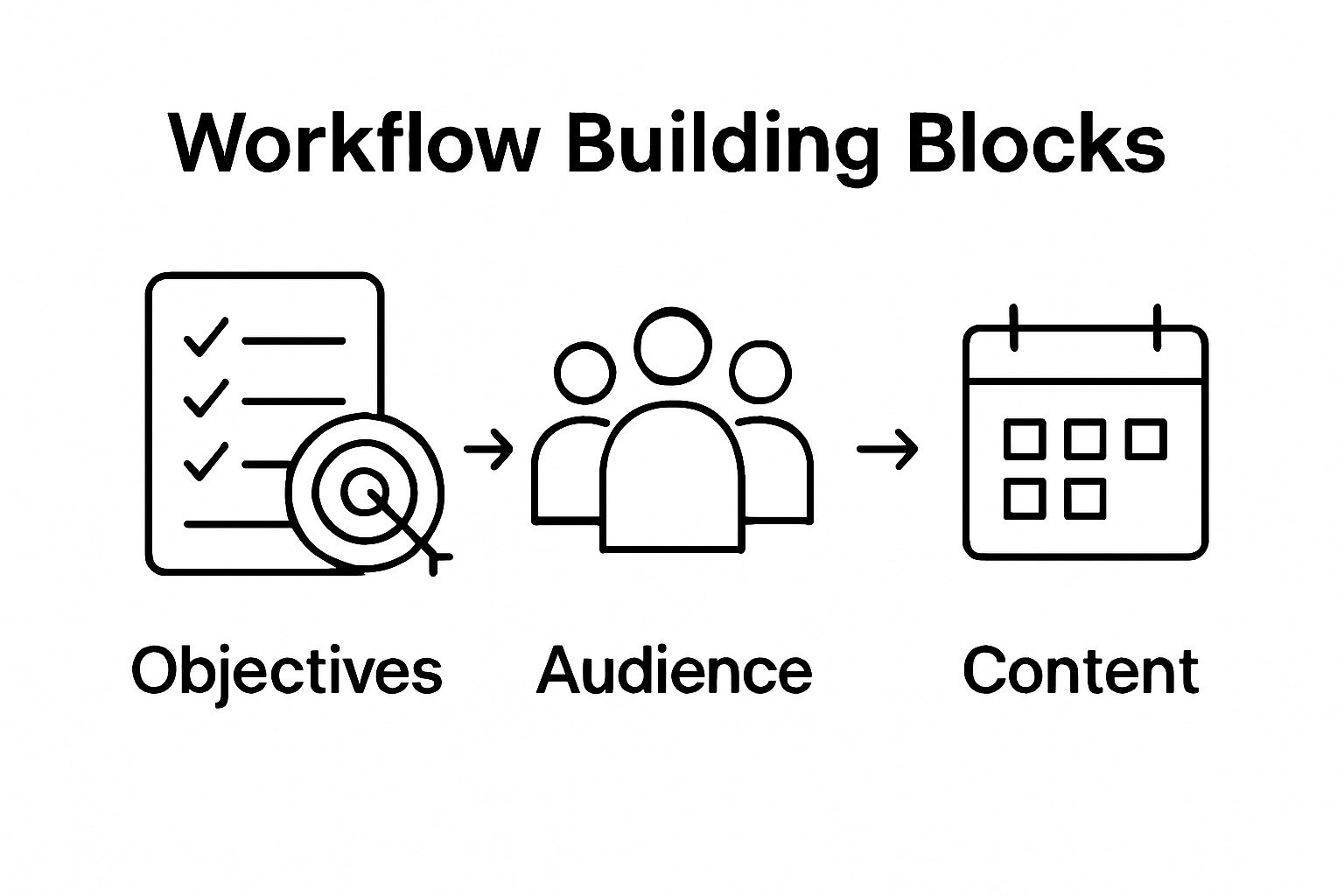
Key components of an effective social media marketing workflow include:
- Defining clear marketing objectives tied to revenue goals
- Identifying target audience personas based on actual customer data
- Content strategy development that aligns with product launches and promotions
- Platform selection focused on where your customers actually engage
- Content creation and curation that maintains brand consistency
- Scheduling and publishing protocols optimized for audience activity patterns
- Performance measurement and analytics that inform real business decisions
Understanding the Strategic Significance for Small E-Commerce Teams
For overwhelmed e-commerce teams already stretched thin between inventory management, customer service, and operations, the traditional approach of manually posting to multiple social channels while trying to track results across separate analytics platforms becomes unsustainable. This fragmented approach leads to inconsistent messaging, missed opportunities, and eventual burnout—the exact opposite of the sustainable growth small businesses need.
Below is a table outlining the key components of an effective social media marketing workflow for e-commerce businesses, summarizing each element and its primary focus:
| Workflow Component | Description | Time Saved with Automation |
|---|---|---|
| Strategic Planning | Set clear marketing objectives and goals | Minimal (human-driven) |
| Audience Identification | Define target personas and market segments | 2-3 hours per campaign |
| Content Strategy Development | Plan types, themes, and formats of social content | 4-6 hours weekly |
| Platform Selection | Choose optimal channels and optimize for each | One-time setup (1-2 hours) |
| Content Creation/Curation | Develop or source engaging, brand-aligned content | 8-12 hours weekly with AI assistance |
| Scheduling & Publishing | Set calendar, automate postings for best timing | 5-8 hours weekly |
| Performance Measurement | Analyze outcomes, track metrics, and make adjustments | 3-4 hours weekly with unified dashboards |
The workflow serves as a strategic blueprint that connects various marketing activities, ensuring that every social media action supports broader business goals. Read more about developing comprehensive social media strategies to understand how systematic approaches can elevate your digital marketing efforts without overwhelming your small team.
Instead of managing separate tools for scheduling, analytics, content creation, and engagement tracking, modern e-commerce teams need everything in one affordable platform. This unified approach eliminates the constant context-switching that drains productivity, reduces monthly software costs from hundreds of dollars across multiple subscriptions to a single predictable fee, and most importantly, handles the technical complexity so you can focus on growing your business rather than troubleshooting integrations.
The Importance of a Structured Workflow in Marketing
A structured marketing workflow is not merely an organizational tool but a survival strategy for small e-commerce businesses competing against well-funded competitors with dedicated marketing teams. By implementing a systematic approach to marketing processes, companies with limited resources can transform their digital strategies from reactive scrambling to proactive planning—leveling the playing field with enterprise-grade capabilities they can actually afford and use.
Breaking Down Strategic Value for Resource-Constrained Teams
Structured workflows provide a comprehensive framework that enables small businesses to align their marketing efforts with overarching business objectives without requiring marketing degrees or expensive consultants. Consistent processes eliminate random actions and replace them with purposeful, measurable strategies. Crucially, this structure becomes even more powerful when your entire workflow lives in one platform rather than requiring you to piece together data and tasks across multiple disconnected systems.
This table compares the advantages provided by a structured social media marketing workflow, clarifying how each benefit impacts e-commerce business operations and outcomes:
| Benefit | Operational Impact | Typical SMB Challenge It Solves |
|---|---|---|
| Enhanced Team Coordination | Improves communication and collaboration | Eliminates “who’s posting what” confusion |
| Reduced Operational Inefficiencies | Streamlines processes and eliminates wasted effort | Stops duplicate work and missed deadlines |
| Improved Content Quality | Ensures consistency and higher standards | Maintains professional appearance despite small team |
| Accurate Performance Measurement | Facilitates data-driven decisions | No more manual report compilation |
| Fast Response to Market Changes | Allows flexibility and quick adaptation | Compete with agile, well-resourced competitors |
| Better Resource Allocation | Maximizes use of budget, staff, and tools | Stretch limited budgets further |
Key benefits of a structured marketing workflow for small e-commerce operations include:
- Enhanced team coordination even when “the team” is just you and one part-timer
- Reduced operational inefficiencies that typically consume 15-20 hours weekly
- Improved content quality and consistency that makes your brand look bigger than it is
- More accurate performance measurement without needing to become a data analyst
- Faster response to market changes like trending products or seasonal opportunities
- Better resource allocation of your most precious assets: time and limited budget
Operational Efficiency and Performance Optimization
A well-designed workflow acts as an organizational blueprint that streamlines marketing activities. It establishes clear responsibilities (even for teams of one), sets standardized procedures that reduce decision fatigue, and creates a repeatable system for executing marketing tasks. For a typical small e-commerce store, this structure can reduce social media management from 20 hours weekly to just 2 hours—saving approximately $2,000 monthly in labor costs while often increasing engagement by 30-40% (though results vary based on implementation quality and consistency). Learn more about developing comprehensive content workflows to understand how systematic approaches can dramatically improve marketing effectiveness.
Companies using marketing automation see sales revenue grow by as much as 56%, according to research from Blue Atlas Marketing, while marketing automation software can lead to a 14.5% increase in sales productivity, per Oracle research. However, these results depend heavily on proper setup, consistent execution, and alignment with business objectives—which is exactly why the ease of implementation matters so much for small teams without dedicated IT resources.
Technological integration plays a crucial role in modern marketing workflows, but it doesn’t need to be complicated. On average, companies make $5.44 for every $1 they spend on marketing automation (a 544% ROI confirmed by multiple industry studies), and small businesses can save 6+ hours per week by automating their social media posts and ads. The key is choosing platforms designed for simplicity rather than enterprise complexity—tools that get you operational in under an hour rather than requiring weeks of complex integrations and technical expertise. This approach transforms marketing from a cost center draining resources to a strategic revenue generator, enabling e-commerce brands to adapt quickly and maintain a competitive edge against larger, better-funded competitors.
Key Components of Effective Social Media Strategies
Effective social media strategies represent a sophisticated approach to digital marketing that goes far beyond simple content posting—yet they don’t require sophisticated technical knowledge when built on the right foundation. For small e-commerce teams, these strategies must balance professional execution with realistic time constraints, delivering enterprise-quality results without enterprise-level complexity or costs.
Understanding Strategic Foundation Without the Overwhelm
A robust social media strategy serves as the architectural blueprint for digital engagement, connecting business objectives with audience expectations—but for small teams, this blueprint must be actionable rather than aspirational. It transforms random social interactions into purposeful communication channels that drive meaningful customer relationships and business growth, all while fitting within the 5-10 hours weekly most small e-commerce teams can realistically dedicate to social media.
Critical strategic components that small teams can actually implement include:
- Precise audience segmentation based on your actual customer purchase data, not guesswork
- Clear brand positioning that differentiates you from marketplace competitors
- Consistent messaging architecture maintained through templates and brand guidelines
- Platform-specific content adaptation automated to fit each channel’s requirements
- Measurable performance indicators focused on revenue impact, not vanity metrics
- Continuous learning and optimization mechanisms built into your workflow, not requiring separate analysis time
Tactical Execution for Teams Without Dedicated Marketers
The reality for most small e-commerce businesses is stark: you’re competing against brands with full marketing departments while wearing multiple hats yourself. 77% of marketers use automation tools to create personalized content for their audiences, according to HubSpot’s 2024 State of Marketing report—and this isn’t optional anymore if you want to compete. The good news is that smart automation can handle the technical execution while you focus on strategic direction and authentic customer relationships.
Successful social media strategies integrate multiple dimensions of digital interaction without requiring you to become a social media expert. They require careful planning that balances creative content development with data-driven insights, but this planning becomes manageable when your platform provides proven e-commerce templates and AI assistance rather than forcing you to start from scratch every time. Explore advanced social media strategy techniques to understand how sophisticated approaches can elevate your digital marketing performance without overwhelming your small team.
Technical proficiency and creative storytelling must work in harmony, but you shouldn’t need a computer science degree to make this happen. E-commerce businesses must develop strategies that not only attract attention but also guide potential customers through sophisticated engagement pathways—from initial discovery through to purchase and beyond. When your platform handles the technical complexity (platform algorithms, optimal posting times, multi-channel formatting), you can focus on what you know best: your products, your customers, and your brand story.
By implementing a holistic approach that combines strategic planning, creative execution, and continuous performance analysis—all within a single unified platform rather than across scattered tools—businesses can transform social media from an overwhelming obligation into a powerful customer relationship and conversion engine that actually fits within small team constraints.
Integrating Social Media Insights into Business Decisions
Social media insights represent a powerful strategic resource that transforms raw digital interactions into actionable business intelligence—but only if you can actually access, understand, and act on these insights without needing a data science team. For small e-commerce businesses, these insights provide unprecedented visibility into customer behaviors, preferences, and emerging market trends, yet traditional analytics platforms often make this data inaccessible through complexity or fragmentation across multiple tools.
Decoding Strategic Intelligence Without Becoming a Data Analyst
Social media data goes beyond vanity metrics, offering deep psychological and behavioral understanding of target audiences—but this value disappears if you spend hours manually compiling reports from Instagram Insights, Facebook Analytics, TikTok Analytics, and Pinterest Analytics separately. By systematically analyzing digital interactions within a unified dashboard, businesses can uncover nuanced insights that traditional market research methods often miss, and crucially, they can do this in minutes rather than hours each week.
Key strategic insights small e-commerce businesses can extract include:
- Customer sentiment and emotional responses to products, prices, and promotions
- Emerging product interest indicators that inform inventory and development decisions
- Competitive landscape analysis showing what resonates (or fails) for similar brands
- Real-time trend identification enabling quick pivots to capitalize on viral moments
- Consumer purchasing intent signals that help prioritize which leads to pursue
- Demographic and psychographic segmentation reveals unexpected customer segments
Transforming Data into Strategic Action Without Technical Complexity
For the typical small e-commerce team already stretched between operations, customer service, and fulfillment, the promise of “data-driven decisions” often feels like an additional burden rather than an advantage. The reality is that social media platforms provide an overwhelming amount of data—the challenge isn’t getting data, it’s getting actionable insights quickly enough to matter without requiring dedicated analyst hours you don’t have.
Successful integration of social media insights requires a sophisticated approach that combines technological capabilities with strategic thinking, but this sophistication should be built into your platform, not required from your team. Businesses must develop robust analytical frameworks that translate digital signals into meaningful strategic directions—or more realistically, they should use platforms that do this translation automatically, highlighting what matters and recommending next steps rather than dumping raw data. Discover advanced techniques for converting social media data into business intelligence to unlock your organization’s full potential without hiring data specialists.
By treating social media platforms as dynamic research environments and unifying the resulting data, e-commerce businesses can create more responsive, customer-centric strategies. This approach enables organizations to move beyond reactive decision-making, instead anticipating market shifts and proactively designing products, services, and experiences that resonate deeply with target audiences. The result is a more agile, intelligent business model that can quickly adapt to changing consumer expectations and competitive landscapes—but only when your analytics don’t require hours of manual report compilation to surface these insights.

Transform Your Social Media Workflow Into Real Results
If you’re tired of random social posts, juggling five different tools, and struggling to connect your marketing steps, you’re not alone. The typical small e-commerce merchant spends 15-20 hours weekly managing social media across fragmented platforms—time that should be spent growing the business, not wrestling with disconnected software. The lack of a structured workflow leads to wasted time, unclear brand messaging, unpredictable growth, and ultimately, the feeling that social media “doesn’t work” for your business (when the real problem is the fractured tool landscape making it impossible to execute consistently).
The Hidden Cost of Tool Fragmentation
Most small e-commerce teams unknowingly pay a “fragmentation tax” in both money and time. Between separate subscriptions for scheduling ($30/month), analytics ($50/month), content creation tools ($40/month), engagement tracking ($35/month), and various other point solutions, monthly costs easily exceed $200-300 while still leaving gaps in functionality. Worse, the constant context-switching between platforms—logging into each tool, manually copying data between systems, and trying to maintain a coherent strategy across disconnected interfaces—creates cognitive overhead that drains productivity and leads to inconsistent execution.
The impact on brand consistency is equally damaging. When you’re copying and pasting between tools, manually resizing images for each platform, and trying to remember which version of your caption you posted where, maintaining professional, on-brand messaging becomes nearly impossible. For small e-commerce teams already stretched thin, manually posting to multiple social channels while trying to run operations becomes overwhelming, resulting in exactly the inconsistent, unprofessional appearance that makes small businesses look small—when you should look competitive, credible, and growth-oriented.
A Better Approach: Unified Workflows That Actually Work
Instead of juggling 5+ separate tools, one AI-driven platform can handle your entire social workflow—and more importantly, do it in a way that’s actually accessible to non-technical users who need results in hours, not weeks. MarketingSuite.app was built exactly for merchants facing these workflow challenges, providing everything SMB e-commerce teams need in one affordable platform that eliminates the technical complexity while maintaining professional capabilities.
The difference is immediately tangible: turn 20 hours of weekly social media work into 2 hours with smart automation that handles repetitive tasks while keeping human oversight where it matters (results vary based on content volume and strategy complexity, but time savings are consistently significant). Our platform lets you seamlessly plan, create, schedule, and analyze your content all in one place—no more logging into multiple platforms, manually transferring data, or paying for overlapping subscriptions.
Core capabilities designed for small e-commerce teams include:
- Multi-channel publishing from a single interface that adapts content to each platform’s requirements automatically
- On-brand automation using customizable templates that maintain professional consistency
- AI-driven content assistance that helps generate ideas and drafts while keeping your unique brand voice (human oversight recommended for all AI-generated content)
- Unified analytics showing complete cross-platform performance without manual report compilation
- Quick-start templates optimized for common e-commerce scenarios (product launches, seasonal promotions, engagement campaigns)
- Intuitive setup that gets your entire social workflow running in under an hour, not weeks of complex integrations
Why This Matters for Competitive Positioning
The playing field in e-commerce has never been more challenging for small businesses. You’re competing against well-funded brands with dedicated marketing teams, sophisticated automation, and enterprise-level tools—making professional social media execution feel impossible without matching their resources. Stop juggling multiple tools when one platform can level the playing field with enterprise-grade automation that small teams can actually afford and use.
Research consistently shows the value of proper automation: while 76% of companies see marketing automation ROI within 12 months (according to industry studies), results depend heavily on implementation quality and consistent execution—exactly what small teams struggle to maintain across fragmented tools. By consolidating your marketing stack, you eliminate the implementation complexity that prevents most small businesses from realizing these benefits, making sophisticated marketing automation accessible rather than aspirational.
The brand consistency advantage alone justifies unification. Maintain professional, on-brand messaging across all channels without hiring a full marketing team—because your templates, brand assets, and approval workflows live in one place, ensuring everything published meets your standards automatically. This consistency makes your business look bigger, more established, and more trustworthy than competitors still cobbling together fragmented approaches.

Take Action: From Overwhelming to Operational
Stop wasting hours jumping between disconnected tools when you can let our AI-driven solution handle the heavy lifting. MarketingSuite.app provides actionable analytics that power smarter decisions, automation that saves 6+ hours weekly (based on typical small e-commerce usage), and the professional appearance that builds customer confidence—all at a price point designed for growing businesses, not enterprise budgets.
Getting started takes minutes, not months. Connect your social accounts, choose from proven e-commerce templates, and let AI optimize your posting schedule based on when your customers are most active. No complex integrations to troubleshoot, no technical expertise required, and no lengthy onboarding process—just practical tools that work immediately.
Ready to publish smarter and scale faster? Learn more and get started today at MarketingSuite.app. Transform your fragmented tool chaos into a unified workflow that actually delivers the results small e-commerce businesses need to compete and grow.
Taking the First Step: Your 48-Hour Workflow Transformation
The difference between e-commerce stores that grow predictably and those that struggle isn’t marketing budget or team size—it’s whether they’ve moved from fragmented chaos to unified workflow execution. Every hour you spend managing disconnected tools, manually compiling reports, or wrestling with inconsistent posting schedules is an hour not spent on product development, customer relationships, or strategic growth decisions that actually move revenue.
Your Immediate Action Plan
The path from overwhelming to operational doesn’t require a complete marketing overhaul or weeks of planning. Start with these concrete steps you can implement within 48 hours:
Hour 1: Audit Your Current Tool Fragmentation List every platform you’re currently using for social media management—scheduling tools, analytics dashboards, content creation apps, engagement trackers. Calculate both the monthly subscription costs and the weekly hours spent switching between them. Most small teams discover they’re spending $200-300 monthly on subscriptions while losing 15+ hours weekly to context-switching—resources that could be redirected toward a unified solution that actually saves time.
Hour 2: Identify Your Biggest Time Drain Is it manually resizing images for each platform? Logging into five different analytics dashboards to compile reports? Forgetting which content you’ve already posted where? Pinpoint the single workflow friction point that wastes the most time. This becomes your first automation priority and the clearest ROI demonstration.
Hours 3-4: Set Up Your Unified Workflow Foundation Choose a platform designed for small e-commerce teams (not enterprise complexity), connect your social accounts, and select quick-start templates relevant to your business. Focus on getting one complete workflow operational—from content creation through publishing to analytics—rather than trying to automate everything at once. Success breeds momentum.
Days 2-7: Validate Time Savings and Refine Track how long your social media tasks actually take with unified workflows versus your previous fragmented approach. Most teams see an immediate 40-60% time reduction in the first week, with savings increasing as they discover additional automation opportunities. Use this validation to justify the transition and build confidence in the new system.
The Competitive Reality
Your larger competitors aren’t succeeding because they work harder—they’re succeeding because they’ve systematized workflows that small teams traditionally couldn’t access or afford. Marketing automation that once required six-figure enterprise contracts and technical implementation teams is now available at SMB price points with setup measured in hours, not months.
The question isn’t whether to automate your social media workflow—it’s whether you’ll automate before or after your competitors do. Every month spent in tool fragmentation chaos is a month where better-organized competitors gain ground, build stronger customer relationships through consistent messaging, and leverage data you’re too busy to analyze.
Beyond Survival to Strategic Advantage
Moving from fragmented tools to unified workflows isn’t just about saving time—though reclaiming 15-20 hours weekly provides obvious operational relief. The real transformation happens when you shift from reactive social media management (scrambling to post something, anything) to strategic digital marketing that actually drives business objectives.
With proper workflow structure, you can:
- Respond to market opportunities in hours instead of days because content creation and publishing aren’t bottlenecked by tool chaos
- Maintain brand consistency that builds customer trust across all channels without manual quality checking
- Make data-informed decisions quickly because your analytics are unified, actionable, and accessible in minutes
- Compete on capabilities rather than budget by accessing automation previously reserved for enterprise teams
- Focus executive attention on strategy rather than execution minutiae that should be automated
Your Next Move
The social media marketing landscape will only become more competitive, more automated, and more sophisticated. Small e-commerce businesses that treat workflow optimization as a nice-to-have rather than a competitive necessity will find themselves progressively unable to compete, not because their products are inferior, but because their operational efficiency can’t match systematized competitors.
You have two paths forward: continue managing fragmented tools that consume hours without delivering proportional results, or consolidate into unified workflows that save time while improving execution quality. The choice is straightforward, but it requires action rather than intention.
Start your workflow transformation today at MarketingSuite.app, connect your accounts, explore quick-start templates, and experience what your social media marketing looks like when the platform handles technical complexity while you focus on growing your business. The competitive advantage of unified workflows isn’t theoretical; it’s measurable in hours saved weekly and revenue grown monthly. The question is simply when you’ll claim that advantage for your business.
Leave a Reply