
AI marketing is turning heads in business for a reason. Nearly 80% of companies use AI in operations, and 75% of marketers are experimenting with or have implemented AI in marketing. (Salesforce) Sounds futuristic, right? Most people think this technology just automates annoying tasks. The surprise is that AI actually learns from every customer interaction, so marketing gets sharper and more personal with every click.
Quick Summary
| Takeaway | Explanation |
|---|---|
| AI marketing enhances customer personalization. | Utilizing AI technologies enables businesses to understand individual customer behavior and create tailor-made experiences. |
| Real-time analytics drive dynamic marketing decisions. | AI can process massive datasets to make instant adjustments in marketing strategies based on current trends or customer actions. |
| Automated systems improve operational efficiency. | Intelligent marketing automation allows businesses to streamline operations, reducing manual workload and enhancing response times for customer engagement. |
| Ethical data usage is essential for trust. | Companies must prioritize transparency and consent management in their data practices to maintain customer trust while using AI technologies. |
| Continuous learning improves AI effectiveness. | AI systems learn from each interaction, making marketing strategies more sophisticated and effective over time. |
Defining AI Marketing and Its Core Concepts
AI marketing represents a transformative approach where artificial intelligence technologies enhance and automate marketing strategies, enabling businesses to deliver more personalized, efficient, and data-driven experiences. Unlike traditional marketing methods, AI marketing leverages machine learning algorithms, predictive analytics, and advanced data processing to understand consumer behavior and optimize marketing efforts in real time.
To clarify the essential elements that power AI marketing, the table below summarizes the fundamental components and how each contributes to enhanced marketing performance.
| Component | Description |
|---|---|
| Data Collection and Analysis | Rapidly processes customer data from multiple sources to extract insights about behaviors and actions. |
| Predictive Analytics | Analyzes historical data to forecast trends, predict behaviors, and recommend personalized strategies. |
| Automated Decision Making | Uses machine learning to make instant marketing choices, like optimizing campaigns or ad targeting. |
The Fundamental Components of AI Marketing
At its core, AI marketing consists of several critical technological components that work synergistically to revolutionize how businesses engage with customers.
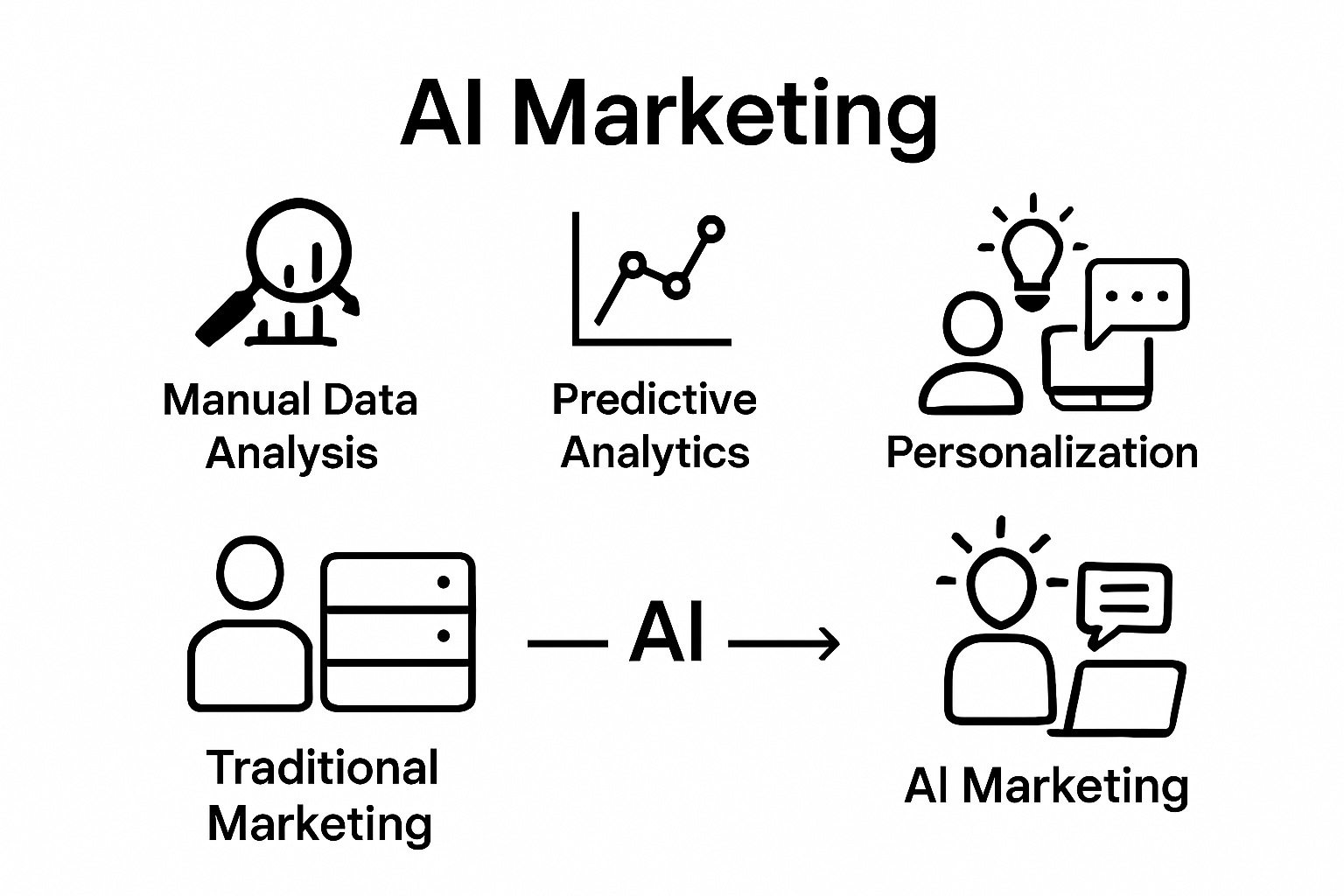 These include:
- Data Collection and Analysis: AI systems can rapidly process massive volumes of customer data from multiple sources, extracting meaningful insights about preferences, behaviors, and potential future actions.
- Predictive Analytics: By analyzing historical data patterns, AI can forecast customer trends, predict purchasing behaviors, and recommend personalized marketing strategies.
- Automated Decision Making: Machine learning algorithms can make instantaneous marketing decisions, such as adjusting ad targeting, recommending product variations, or optimizing campaign parameters.
How AI Marketing Transforms Customer Interactions
AI marketing fundamentally changes customer interactions by enabling hyper-personalization and real-time responsiveness. Through advanced algorithms, businesses can now create individualized experiences that feel tailored to each customer’s unique journey. For instance, AI can dynamically adjust website content, recommend products, or send personalized email communications based on a user’s specific browsing history and previous interactions.
Businesses leveraging AI marketing gain significant competitive advantages by understanding and anticipating customer needs more precisely than ever before. Learn more about the role of AI in content creation to understand how these technologies are reshaping marketing strategies across industries.
The power of AI marketing lies not just in automation, but in its ability to continuously learn and improve. Each customer interaction provides new data points that refine the system’s understanding, making marketing efforts increasingly sophisticated and effective over time.
Understanding the Importance of AI Marketing in E-Commerce
E-commerce businesses are experiencing a profound transformation through AI marketing, which enables unprecedented levels of customer understanding, personalization, and operational efficiency. By integrating advanced artificial intelligence technologies, online retailers can now create more intelligent, responsive, and targeted marketing strategies that significantly enhance customer experiences and drive revenue growth.
AI Marketing as a Competitive Advantage in Online Retail
In the highly competitive e-commerce landscape, AI marketing provides businesses with critical strategic advantages. These technologies allow companies to move beyond traditional demographic segmentation and create truly individualized customer experiences. By analyzing complex behavioral patterns, purchase histories, and real-time interactions, AI systems can generate hyper-personalized recommendations and marketing approaches that feel uniquely tailored to each customer.
- Precision Targeting: AI algorithms can identify micro-segments within customer populations, enabling extremely precise marketing communications.
- Dynamic Pricing Strategies: Intelligent systems can adjust product pricing in real-time based on demand, competition, and customer willingness to purchase.
- Predictive Customer Behavior: Advanced machine learning models can anticipate customer needs before they explicitly express them.
Transforming Customer Engagement Through Intelligent Technologies
AI marketing fundamentally reimagines how e-commerce businesses interact with customers. Intelligent chatbots provide immediate, personalized customer support. Recommendation engines suggest products with remarkable accuracy. Automated email campaigns adapt in real-time based on individual customer interactions.
Learn more about AI’s role in e-commerce to understand how these technologies are revolutionizing online retail strategies. The most successful e-commerce businesses recognize that AI is not just a technological tool, but a comprehensive approach to understanding and serving customers more effectively than ever before.
The future of e-commerce marketing lies in this intelligent, adaptive approach. By embracing AI technologies, businesses can create more meaningful connections, anticipate customer needs, and deliver experiences that feel intuitively personalized and responsive.
Exploring How AI Enhances Customer Insights
AI technologies have revolutionized the way businesses understand and interact with their customers, transforming raw data into meaningful, actionable insights that drive strategic decision making. By leveraging sophisticated algorithms and machine learning techniques, companies can now decode complex customer behaviors and preferences with unprecedented depth and accuracy.
Decoding Customer Behavior Through Advanced Analytics
Traditional market research methods often rely on broad demographic data and manual analysis, which can miss critical nuanced insights. AI-powered customer insight tools eliminate these limitations by processing massive datasets across multiple touchpoints, revealing intricate patterns that human analysts might overlook. These intelligent systems can track and analyze customer interactions in real-time, creating comprehensive profiles that go far beyond simple demographic information.
- Emotional Intelligence Analysis: AI can interpret subtle emotional cues in customer communications, understanding sentiment and underlying motivations.
- Predictive Behavioral Modeling: Machine learning algorithms can forecast future customer actions based on historical interaction patterns.
- Cross-Channel Integration: AI synthesizes data from websites, social media, mobile apps, and customer service interactions to create holistic customer understanding.
Transforming Raw Data into Strategic Intelligence
The true power of AI in customer insights lies in its ability to convert complex data streams into clear, actionable strategic recommendations. By analyzing thousands of data points simultaneously, these systems can identify emerging trends, predict potential customer churn, and suggest personalized engagement strategies that feel intuitive and timely.
Discover more about customer engagement strategies to understand how AI is reshaping customer relationship management. Businesses that embrace these technologies gain a significant competitive advantage, moving from reactive to proactive customer engagement models.
AI-enhanced customer insights represent more than just technological innovation.
 They signify a fundamental shift in how businesses understand, respect, and serve their customers—creating more meaningful, personalized experiences that drive loyalty and long-term growth.
Real-World Applications of AI Marketing Strategies
AI marketing strategies are no longer theoretical concepts but practical tools transforming how businesses engage with customers across multiple industries. By integrating intelligent technologies, companies can create more responsive, personalized, and efficient marketing approaches that deliver measurable results and significant competitive advantages.
Intelligent Marketing Automation in Practice
Modern businesses are deploying AI marketing strategies across diverse operational domains, revolutionizing traditional marketing approaches. These intelligent systems go beyond simple automation, offering sophisticated capabilities that adapt and learn from each customer interaction. From e-commerce platforms to service-based industries, AI enables businesses to create dynamic, responsive marketing experiences that feel uniquely tailored to individual customer needs.
- Personalized Product Recommendations: AI algorithms analyze browsing history, purchase patterns, and customer preferences to suggest products with remarkable precision.
- Dynamic Content Generation: Intelligent systems can create marketing materials that automatically adjust based on user demographics, interests, and engagement history.
- Real-Time Customer Segmentation: Advanced machine learning models continuously refine customer groups, enabling more targeted and effective marketing communications.
Transforming Customer Interactions Through AI
The most innovative companies are using AI to reimagine customer interactions, moving beyond traditional engagement models. Intelligent chatbots provide instant, personalized support. Predictive analytics anticipate customer needs before they are explicitly expressed. Automated email campaigns adapt in real-time, delivering messages that resonate with individual customer journeys.
Explore the advantages of automated marketing to understand how these technologies are reshaping marketing strategies. The most successful organizations recognize that AI is not just a technological tool, but a comprehensive approach to understanding and serving customers more intelligently and effectively.
AI marketing strategies represent a fundamental shift in how businesses communicate, predict, and respond to customer needs. By embracing these intelligent technologies, companies can create more meaningful connections, deliver truly personalized experiences, and drive sustainable growth in an increasingly competitive marketplace.
Key Challenges and Considerations in AI Marketing
While AI marketing offers transformative potential, businesses must navigate a complex landscape of technological, ethical, and operational challenges. Successfully implementing AI marketing strategies requires a nuanced understanding of potential limitations and strategic approaches to mitigate risks and maximize opportunities.
The table below outlines major ethical and operational challenges businesses may encounter when implementing AI marketing, along with examples of each consideration.
| Challenge Type | Key Consideration | Example or Approach |
|---|---|---|
| Ethical | Data Protection | Create policies that clarify data collection and usage for customers. |
| Ethical | Algorithmic Transparency | Allow customers to see how AI-driven marketing decisions are made. |
| Ethical | Consent Management | Provide clear mechanisms for customer data control and permissions. |
| Operational | Data Quality and Consistency | Maintain accurate, clean, and comprehensive data for analysis. |
| Operational | Skill Development | Offer training to enhance team competency in AI tools and techniques. |
| Operational | Technological Integration | Design systems that smoothly merge AI into existing marketing workflows. |
Ethical and Privacy Considerations
The integration of AI technologies in marketing raises critical questions about data privacy, consent, and algorithmic transparency. As AI systems become more sophisticated in collecting and analyzing customer data, businesses must establish robust frameworks that protect individual privacy rights and maintain customer trust. This involves implementing clear data governance policies, ensuring transparent data usage, and providing customers with meaningful control over their personal information.
- Data Protection: Develop comprehensive policies that clearly communicate how customer data is collected, processed, and utilized.
- Algorithmic Transparency: Create mechanisms that allow customers to understand how AI-driven decisions are made.
- Consent Management: Implement user-friendly consent systems that give customers granular control over their data.
Technical and Operational Challenges
Successful AI marketing implementation requires more than technological investment. Organizations must address significant technical and operational barriers that can impede effective AI integration. These challenges include data quality issues, skill gaps in AI understanding, and the complexity of integrating AI systems with existing technological infrastructure.
- Data Quality and Consistency: Ensure high-quality, clean, and comprehensive datasets that enable accurate AI analysis.
- Skill Development: Invest in training programs that enhance team capabilities in AI technologies and data interpretation.
- Technological Integration: Design flexible systems that can seamlessly incorporate AI technologies into existing marketing workflows.
AI marketing represents a powerful but complex technological frontier. Learn more about navigating marketing automation challenges to understand how businesses can effectively leverage these technologies. The most successful organizations will be those that approach AI not as a standalone solution, but as a strategic tool requiring continuous learning, ethical consideration, and human oversight.
Ready to See the Real Impact of AI Marketing on Your Business?
If you have ever felt overwhelmed by endless marketing tasks or frustrated by the challenge of turning customer data into real growth, you are not alone. As discussed in this article, understanding and harnessing AI marketing means transforming data into strategic action, delivering true personalization, and making sense of complex customer journeys. These are the very pain points that stop many small and mid-size e-commerce businesses from scaling up and keeping pace with competitors. See how Marketing automation can make a difference for your team.

Stop juggling multiple tools and start using the all-in-one MarketingSuite.app platform. It is time to experience advanced features like AI-driven content, automated email, and AI customer chat, all designed to help merchants like you publish faster, target smarter, and drive profitable growth. Discover more in our Customer Engagement section to see proven strategies. The opportunity to streamline your marketing and unlock growth is right here—visit MarketingSuite.app to start your transformation today.
Turning AI Insights into E-Commerce Growth
Bringing AI into your marketing isn’t just a tech upgrade; it’s a strategic catalyst that turns raw data into real revenue. By embracing AI-driven personalization, dynamic pricing, and real-time analytics, online retailers can deliver experiences so relevant they feel custom-built for each customer.
To make AI work for your webshop right now, focus on three practical steps:
- Audit Your Data Foundations: Verify that customer records, purchase histories, and browsing data are clean, complete, and unified. A solid data backbone ensures your AI models learn from accurate inputs and deliver trustworthy recommendations.
- Pilot a High-Impact Use Case: Choose one area—product recommendations, email personalization, or chat automation—and implement an AI-powered tool in a small test. Measure uplift in engagement, conversions, or support resolution times before scaling broadly.
- Embed Continuous Learning: Schedule regular model retraining and review AI outputs with your marketing team. Blend algorithmic insights with human creativity to refine messaging, offers, and campaign timing week over week.
By auditing your data, piloting a focused AI initiative, and committing to iterative improvement, you’ll transform one-off experiments into a sustainable engine for smarter customer experiences and stronger e-commerce performance. The next click counts; start your AI pilot today and watch your webshop evolve from reactive to anticipatory, delighting customers at every turn.
Ready to be part of the marketing technology revolution? Sign up for our Free Beta and get exclusive access to cutting-edge automated marketing innovations. Join our community of visionary marketers who are shaping the future of customer engagement!
Leave a Reply